

What Babies Need to Thrive
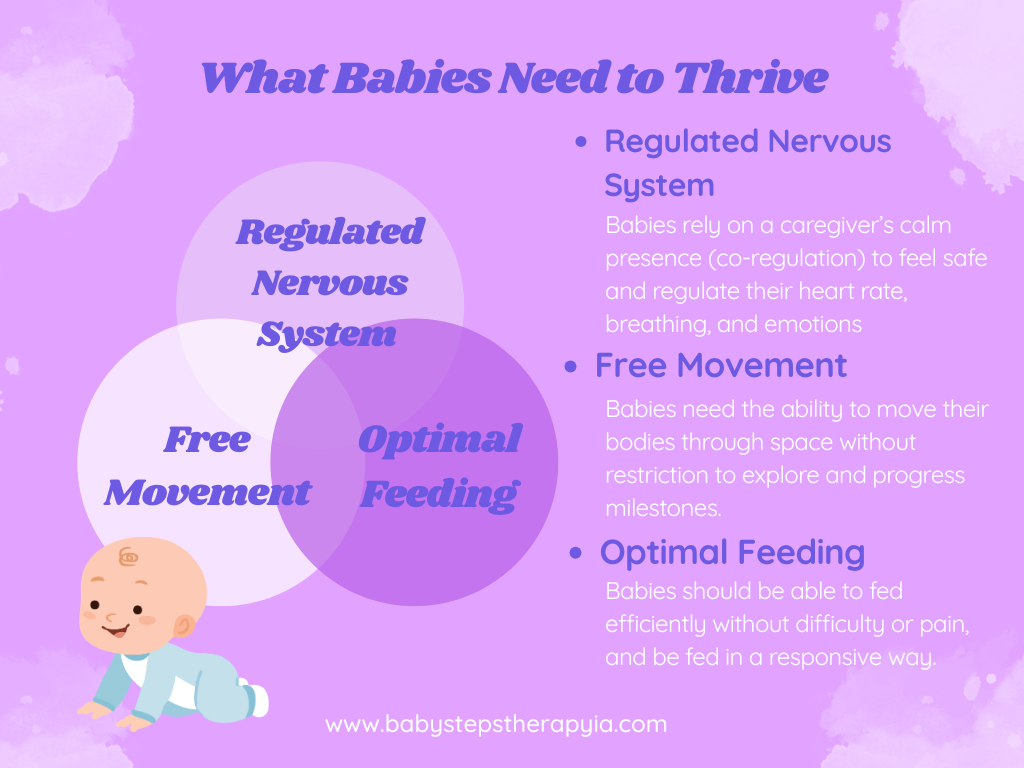
The foundations of what Baby Steps Therapy aims to support is a thriving baby that is able to co-regulate with their caregiver, move freely and comfortably, and feed efficiently. These foundations are intertwined with each other and therefore cannot be fully treated in isolation of each other. This is where my unique training and experience is essential and convenient for families as I am able to evaluate and support all 3 foundations. As a physical therapist I am able to evaluate baby’s alignment, strength and coordination of their muscles, and the appropriate flexibility of all muscles and joints to allow baby to perform gross and fine motor skills as well as be able to use their oral motor skills to efficiently feed from the breast or bottle. As a lactation consultant I am able to evaluate the dyad of baby and caregiver to assess milk supply, baby’s feeding skills, co-regulation between baby and caregiver during feeding, and establish feeding plans. My craniosacral therapy training also supports baby and caregiver’s nervous systems, improves fascial flexibility, and improves feeding outcomes.
Example Situation:
Baby is born with torticollis (tightness in the neck) that affects baby’s neck alignment and the pull on their jaw and tongue muscles. This affects baby’s ability to efficiently feed and causes them discomfort being held in certain positions that do not allow them to move their head towards their tight side. This can cause pain or difficulty with breastfeeding, especially on one side versus the other. This could lead to inefficient milk removal, poor weight gain, and over time can decrease mother’s milk supply. Frequently in these cases the baby also has digestive discomfort from swallowing excessive air that can cause reflux and pain. Excessive crying then leads to dysregulated nervous system of both mother and baby.
Example Treatment:
-Craniosacral therapy to decrease fascial tension around the head and neck as well as treat or prevent flatness occurring to the side of the head baby is always turned towards. Education on co-regulation techniques to improve nervous system regulation for both baby and caregiver.
-Physical therapy evaluation and treatment of the torticollis showing caregivers a home exercise program consisting of stretches, positioning changes, and strengthening exercises. As tension improves around the neck and jaw, feeding improves as well.
-Lactation consultation including assessment of milk supply, milk transfer, positioning baby in comfortable positions for baby and mother, improving latch to resolve pain at breast, and creating a feeding plan based on caregiver’s goals and baby’s health and growth.
-Continued support to progress towards goals and progress baby’s mobility and milestones
Have more questions? Reach out to me at laurie@babystepstherapyia.com!
